Online identity at the heart of the debate. This week, the controversial Worldcoin announced the launch of its token WLD. In the hours that followed, Vitalik Buterinco-founder ofEthereum has taken up the subject. Let’s take a look back at his analysis of the project and the challenges of online identity.
Worldcoin: online identity secured by biometrics
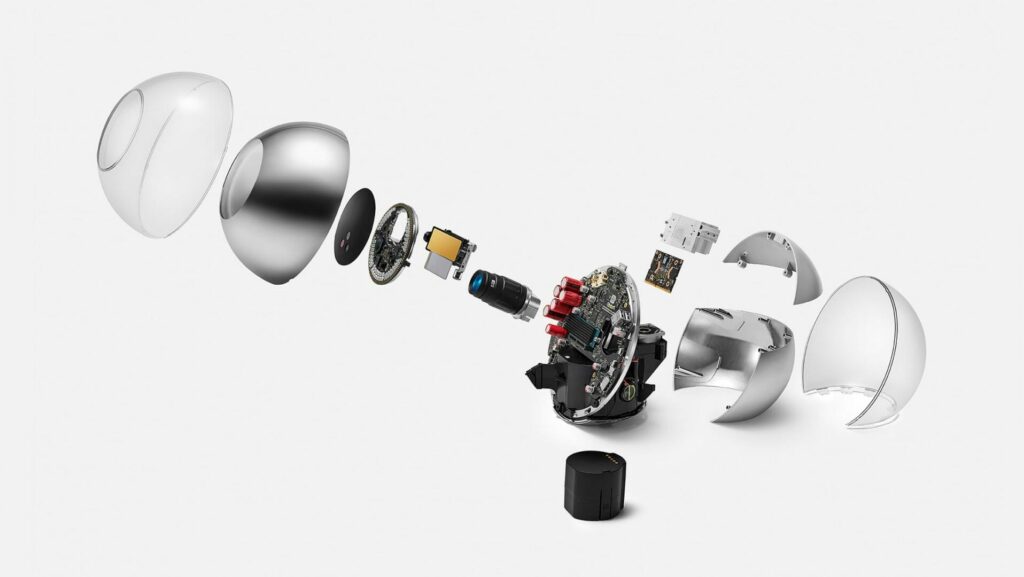
Launched in October 2021, Worldcoin is a project that aims to set up an online forgery-proof digital identity system. To this end, Worldcoin has created a device called Orbs. In practice, these Orbs can be used to iris scanning and associate it with a digital identity.

It is therefore theoretically impossible for the same user to have two different identities. This is because his digital identity is linked to his biometric identity, as recorded by the Orb.
On July 24, Worldcoin teams unveiled the launch of the second phase of their project: the WLD token.. This token is presented as a attempt at a universal income. More than 2 million users who had their irises scanned were awarded tokens.
What can we expect with Worldcoin?
As you probably know. Vitalik Buterin is passionate about sharing his thoughts on his personal blog. On July 24, a few hours after the release of WLD, Vitalik published a article entitled « What do I think about biometric proof of humanity? ».
As usual, before getting to the heart of the matter, Buterin introduces several concepts necessary for understanding the subject. He briefly introduces the Worldcoin project and the concept of digital identity.
« Proof of identity, also known as the ‘one-man problem’, is a limited form of real-world identity that asserts that a given registered account is controlled by a real person (and a different real person from all other registered accounts), ideally without revealing which real person it is. »
A topic already widely addressed in the Ethereum ecosystem. We can cite the initiatives of Proof of Humanity, BrightID, Idena and Circles in particular.
In his view, proof of identity is extremely valuable. It solves many problems, such as spam, the concentration of power and the protection of privacy:
« If the proof-of-personality problem is not solved, decentralized governance (including ‘micro-governance’, such as voting on social media posts) becomes much easier to capture by very wealthy actors, including hostile governments. »
Vitalik Buterin: not a big fan of Worldcoin’s approach
Although he recognizes an interesting innovation in Worldcoin’s approach, he is no less critical.
He identified four main problems related to Worldcoin’s architecture:
- The privacy The iris scan register contains extremely sensitive data. Without talking about leaks, a scan of your iris by a third party can allow them to obtain information about you, by comparing it with the iris database ;
- L’accessibility These global identifiers will not be accessible to the entire population. This requires the massive installation of Orbs around the world;
- The centralization The Orb is a central point of failure in the system. Indeed, its design depends on a centralized entity. As a result, even if the Worldcoin software layer were perfect and entirely decentralized, the Worldcoin Foundation would still have the possibility of inserting a backdoor into the system via the Orb ;
- The safety There are risks in terms of hacking into users’ phones. There’s also the risk of being forced to scan an iris with a key that doesn’t match, or of creating fake people by 3D printing fake irises.
Even so, he points out that some of these risks are not specific to Worldcoin :
« It is important to distinguish between the problems specific to the choices made by Worldcoin, the problems that any biometric proof of personhood will inevitably pose, and the problems that any proof of personhood in general will pose. »
The risks of digital identity according to the co-founder of Ethereum
Vitalik Buterin also addresses the more general risks posed by digital identity. Digital identity could link all a user’s activities to his or her identity. As a result, this data is extremely sensitive, and its leakage could have disastrous consequences.
However, he sees a solution obvious: the zero knowledge proofs. As a reminder, these are proofs that allow us to prove mathematically that a piece of information is true, without having to reveal that information.
« Instead of directly affixing a signature with a private key whose corresponding public key is in the database, a user could affix a ZK-SNARK proving that he possesses the private key whose corresponding public key is somewhere in the database, without revealing the specific key he possesses. »
Vitalik Buterin
Alternatives to biometrics
Of course, digital identities are not necessarily linked to a biometric identity. As Buterin explains, there are a multitude of other methods for creating and managing digital identities:
- The evidence of human activity This method is based on the idea that certain activities are sufficiently difficult to automate to serve as proof of humanity. On the other hand, it could lose reliability in the face of the rise of AI;
- The proof of social activity This method uses social interactions as proof of human identity;
- The proof of work this method would use human labor as proof of identity: for example, by working a certain number of hours. Unfortunately, this method is vulnerable to fraud;
- The proof of life This method relies on birth certificates. However, it is also vulnerable to fraud and corruption.
Vitalik concludes by noting that none of these methods is perfect, and all present challenges and trade-offs. He suggests that solution could lie in a combination of these methodsrather than a single approach.
Finally, these notions of digital identity, particularly their security and confidentiality, will take on a whole new dimension in the age of MNBC. Indeed, MNBCs, coupled with insecure or overly centralized digital identities, could open the gates to dystopia. In the meantime first black markets for personal data The first black markets for personal data of Worldcoin users seem to have already appeared on the…
Are you a bit overwhelmed by the dark business of iris scans and personal data? Go to rather register with Binance THE leading crypto platform, and get 10% off your trading fees for life! (commercial link)