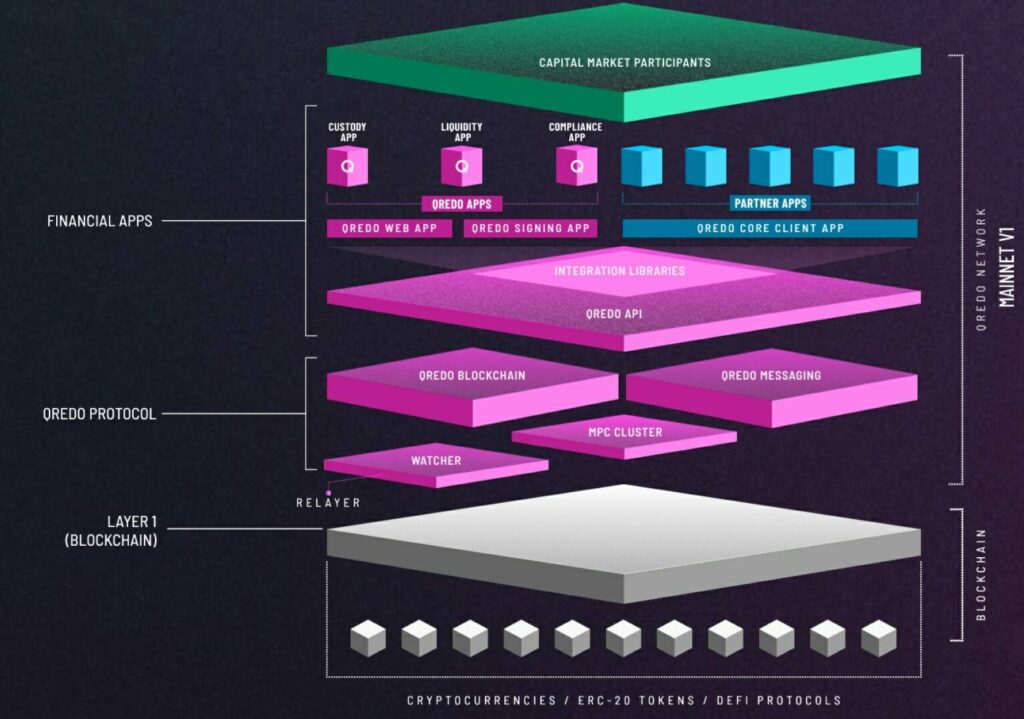
Qredo is both a protocola network and a platform secure, easy-to-use digital asset custody platform. The company offers a wide range of products and servicesfor individuals, businesses and financial institutions.
Qredo meets structural challenges which the crypto-economy is facing. Indeed, between fragmented liquidity, single points of failure in private key management and very long completion times, the crypto industry must provide solutions for institutional levelin terms of safety and complianceto attract new capital.
Qredo’s proposed Secondary Layer Protocol provides a robust infrastructure for securing and exchanging digital assets in a global multi-chain.
What is Qredo?
Qredo is above all a digital asset custody protocol based on the multiparty calculation (Multi-Party Computation or MPC). It responds to the challenges posed by private key management (storage and access control).
It’s also a clearing and settlement network for cryptoassets, quality institutional. In addition to simply securing assets, its infrastructure makes it possible to transfer cross-chain. The platform enables organizations from all sizes to develop their financial operations on digital assets.
The securing of private keys and signatures is based on the specific implementation of a multiparty distributed computing networkdeployed on secure execution environments (TEE).
Multiparty calculation (Multi-Party Computation or MPC):
Secure multiparty computation allows agents in a communication network to jointly compute a function on their inputs, so that the inputs remain private and the result is exact. This method is different from a multi-signature wallet: the signing process takes place off-chain, thanks to a network of nodes each possessing a secret – part of the private key. It’s a fast, low-cost, confidential and blockchain-agnostic solution.
Secure execution environment (Trusted Execution Environment or TEE):
A TEE is a secure, isolated area of a microprocessor, preventing unauthorized entities from altering the calculations or code deployed. This execution environment is more secure than an operational system, and more functional than a secure element (SE, found for example on hardware wallets). Intel’s SGX enclaves (Intel Software Guard Extensions) are well known in the world of distributed computing.
The blockchain of the secondary layer proposed by Qredo (the QredoChain) ensures state transitions and MPC signatures thanks to its consensus mechanism based on Tendermint. Any organization can use it to manage private keys and signatures for its digital assets, without relying on a central entity. Its architecture allows users and to developers to represent the property of assets, and to define governance andaccess. It therefore eliminates the counterparty risk while providing the highest degree of safety possible.
Qredo’s team
It is made up of more than 200 members in various countries. The project was founded in the last quarter of 2018 by Anthony Foy and Brian Spector. First, after a round of financing from 2.9 million of dollars in pre-seed, the first MVP saw the light of day in late 2019: a cryptoasset custody app on-chain. Initially developed within the incubator Apache Milagrothe first Testnet was deployed in the second quarter 2020.
The Mainnet 1.0 appeared a few months later. By the end of 2020, it enabled distributed guarding of BTC andETHas well as instantaneous transfers and native exchanges between the two cryptocurrencies. Start 2021the Qredo team raised funds in seed from 11 million investors include Deribit, Wintermute, GSR and CMS Holdings.
During the year 2021, HedgeGuard integrated Qredo’s solution, while MVP supported the top 13 ERC-20 chips. The QRDO token token was launched in the same year, with 32,000 holders. Qredo then made its appearance in El Salvador, bringing decentralized finance to Banco Hipotecario. At the end of the year, Deribit began using Qredo for its custodial infrastructure.
Qredo took on a new dimension during the year. 2022. Indeed, the series Aled by 10T Holdings, raised 80 millionwith strategic investments from Coinbase Ventures and Avalanche. The team grows to 200 employees and acquires the Xena foreign exchange platform, then integrates WalletConnect and programmatic access to DeFi.
To better understand Qredo at the level of its protocolwe need to review a triptych of concepts.
The secondary layer infrastructure proposed by Qredo
Qredo is based on a distributed networkwhere different objects (documents) are used to perform various types of operations on digital assets, from their simple preservation secured to instant exchanges. This architecture eliminates single points of failure in private key management. Similarly, there’s no longer any need to rely on a central entity to administer your digital assets, whether you’re an individual or an organization.

Let’s discover Qredo’s various components and the services offered by the platform.
Network services
At the network layerQredo is based on three types of node.
Qredo MPC nodes
They are distributed and ensure the generationthe storage and theuse of private keys. Qredo’s MPC implementation thus eliminates the single points of failure inherent in traditional private key storage. These MPC nodes operate in a TEEand are governed by the QredoChain.
Validators
These nodes are responsible for verification and validation of transactions carried out on the network. They participate in the consensus mechanism (based on Tendermint) to maintain network integrity.
Observers (watchers)
These are the oracles of the network, which synchronize the state of Layer 1 chains (such as the Ethereum blockchain) with that of the QredoChain. They enableidentify and validate the depositsas well as the results of withdrawal requests.
Governance documents on-chain by Qredo
Three digital documents govern the majority of actions carried out via the protocol.
Wallet Document
This object governs private keys and assets within the custody protocol. He established a link on-chain between a key (generated by the MPC node network) and theuser. The latter is identified by a BLS public key (based on the signature scheme Boneh-Lynn-Shacham) and linked to a set of rulesgoverning access to the key (the Policy).
The portfolio documents are of two types:
- A Web3 Wallet Document relates to the custody of a key;
- A Vault Wallet Document concerns the custody of an asset.

Policy
This is theset of rules governing theaccess and theusage from keys and assets within the Qredo protocol. The user can define and customize the rules, thanks to various authorization levels and recovery of varying degrees. These rules can be applied to portfolio documents, and determine the conditions under which transactions can be approved. They generally comprise several identity documentsincluding validators can evaluate the complianceto generate an event securely.
Identity Documents
The identity documents are the cryptographic record of a user’s identity within the protocol. This is represented by a BLS public key This allows it to interact with the protocol in full security. security and without compromising its confidentiality. This means that only authorized third parties can access its keys or assets.
The different operations on QredoChain
Operations on-chain facilitating movement of funds involve portfolio documents. They must be authorized via a sufficient number of BLS signaturesin order to satisfy rules defined above for the wallet (Policy).
Primer and deposits
At the time of its creation, a Qredo portfolio is always associated with a Layer 1 (BTC, ETH, etc.) It is associated with a public address on Layer 1, generated by multiparty calculation. The Observer monitors the address on Layer 1, and when a deposit is detected, an underlying transaction is broadcast on Layer 2. This transaction then credits the user’s Qredo wallet balance with the corresponding funds.

Primer and shrinkage
When a user initiates a withdrawaland if the request complies with the set rulesa Validator creates the corresponding transaction (unsigned). The validator has a full mapping between Layer 1 and Layer 2 assets: this is called crystallization. The observer will then route this transaction to the MPC nodes (which ensures that the transaction exists on-chain). It is then signed and sent back to the observer for broadcast, and the user obtains a receipt confirming the success of the operation.
External portfolio requests
These are portfolio updates containing raw dataprovided by its owners. This enablesuser from control directly its address on Layer 1, and sign transactions or other data. Qredo’s blockchain applies predefined rules (Policy), and keeps a record of all transactions. immutable record history of requests of a portfolio, as well as signatures generated via multiparty calculation. This functionality is used by MetaMask Institutional or WalletConnectand compatible Web3 APIs to facilitate transaction signing.
The secondary layer (Qredo) and transfers
The transfers carried out between Layer 2 portfolios, including atomic swapsare carried out by validatorswithout going through the MPC nodes or the observer. They must comply with predefined rules to be authorized.

General operation of Qredo
We won’t go into pure technical details in this introductory article. We will simply describe the overall operation of the system. To do this, we need to review various components and processes.
Accounts and API keys on Qredo
To use the Qredo application, all users must first create a personal account. Personal accounts can be linked to one or more organization accounts. Any organization can have multiple funds or portfolios. This allows several personal accounts to be share management an organization account.
Each member of an organization may have one or more roles :
L’Director has the highest level of access. He controls the Organization, and can access Funds and Portfolios. He can add or remove members, and submit, approve or reject transactions. The Administrator is also the only person who can create API keys and secret pairs for the Organization.
A Fund Organizer (Fund Organizer) has control over Fonds and Portfolios for which he is appointed. He may create as many portfolios as he wishes, within a Fund over which he has control.
L’Approver (Approver) has control over transfersthe atomic swapsand withdrawals within the portfolios to which they are assigned. He carries out his tasks via thesignature application Qredo.
The Trader can initiate transfers atomic swaps and withdrawals for any portfolio, when its predefined rules entitle it to do so.
The administrator can therefore perform any of the actions possible for the other roles. The API keys are part of the cover layer (custody layer) and are created and configured by the administrator. They can provide access at account level (personal or organizational) and also at portfolio level.
Approvals
The rules of custody (Policies) require approval for any transaction created, and for any request transferring assets out of a Qredo portfolio (withdrawals), before they can be effective.
Visit approvers are all entities that have created a personal account on Qredo and have taken on the role of custodian. They are designated via the mobile application and operate via thesignature application. It can also beautomatic signing agentsprogrammed to approve or reject requests according to specified constraints.
Approvers, also called trusted partiesform a network of trust (trusted network). Each company or organization therefore has one or more approvers, with control over transactions relating to the funds or portfolios concerned.
Approver groups and custody rules can be customized.
Transactions with Qredo
A transaction must be signed before it can be broadcast. With Qredo, only transactions that meet the required predefined criteria can be signed. Thanks to multiparty calculation, Qredo eliminates the single point of failure of conventional private key systems. In addition, another single point of failure (reliance on a single signatory) is eliminated, thanks to guard rules and multiple approvers.
When creating a transaction, Qredo takes care of three tasks:
- The collection required approvals ;
- The signature of the transaction ;
- The renvoi of the transaction, signed and ready for distribution.
The diagram below summarizes the life cycle of a transaction:

The flow of theAPI Qredo’s API therefore ends when the transaction is approved, signedand ready for broadcast. The API enables transactions legacy (classic) and EIP-1559 (including tip forEthereum), your choice.
Transfers
The outgoing transactions (transfer out) are subject to approval. These are the following types:
- Layer 2 transactions, from one Qredo portfolio to another Qredo portfolio;
- Transactions from Qredo to Layer 1 (withdrawals) using crystallization;
- Atomic exchanges (atomic swaps) on Qredo (e.g. swaps qETH/qBTC).
The incoming transactions on Qredo (transfer in) such as deposits do not require any approval from the trusted network.
Portfolios and Funds
A Qredo portfolio holds and/or provides custody of digital assets. Each type of asset is associated with its own wallet. The user can create an infinite number of wallets. Each grouping of portfolios is called Funds.
There are three classes of portfolios: connected, standard and jacketd. In the case of a connected wallet, the assets are located on the corresponding Layer 1, and Qredo acts as a secure layer for the custody of these assets. Transactions are subject to approval via Layer 2, but the Qredo wallet does not hold the assets.
Using a standard wallet, the assets are on both Layer 1 and Layer 2. As for the vestedi.e. a custodian portfolio, the assets are on Layer 2.
The 6 types of Qredo users
There are six types of user on the network.
Market Makers
The market makers continuously provide asset quotations for tradersbuying and selling. In order to become market makerYou must deposit a minimum quantity of assets and lock tokens. QRDO in a portfolio of staking. The quantity of QRDOs to be locked depends on the network’s economic activity.
Validators
The validators must deposit QRDO tokens in a portfolio of staking to participate. These are rewarded directly by the Qredo protocol for their verification work.
The Traders
These are the individual users or the organizations that use Qredo’s Layer 2 for exchange assets with a third party. They use the network’s tertiary layer for encrypted, decentralized communication and produce RFQ. These quotation requests (Requests for Quote) are sent to Market Makers in order to finalize a atomic swap on layer 2.
Custodians
The Custody Users use Qredo to ensure secure custody of their assets. They can therefore also become tradersif they wish.
Liquidity providers
Visit Liquidity Providers deposit assets in pools by Qredo (the liquidity reserves of the protocol) and generate interests when other users borrow these funds, thanks to fees.
Borrowers
Version 2.0 of the Qredo protocol makes it possible to borrow cash within Loan Pools. This may involve making trading with leverto take out instant loans (flash loans), or to generate passive income from cash (yield farming).
The tertiary layer: the RFQ system
This system (Request for Quote or quotation request) enables users to communicate with market makers via a dedicated layerLayer 3. This method is asymmetrical :
- First, the Trader submits a request (request for quote) ;
- Next, a set of market makers provides the quotation for the asset traded (supply and demand) ;
- Finally, the protocol offers the user the possibility of best quotation on the market.
The QRDO token and its tokenomics
The business model Qredo utility token (QRDO) is user-centricaround the following axes:
- Firstly, a set ofeconomic incentives aligns the interests of depositors traders and market makers ;
- Then, the active participation of these three types of users generates a income for validators and market makers ;
- As a result, it reinforces the security of the network. As the value of user deposits increases, more validators can participate in the consensus. Attacks (by malicious validators) therefore become increasingly costly.
The idea behind this model stems from the fact that the economic incentives for players on a Layer 1 are not suitable for a Layer 2. On a primary layer, validators or miners benefit from theinflation of the native token, determined by the protocol. However, a Layer 2 is a form of middlewarea bridge between guard and theexchange of Layer 1 assets, in order to decentralized and without trusted third party.
Qredo’s model is therefore designed to reward both users and the validatorsto symbiotic. The market makers benefit from theeconomic activity taking place on the network, thanks to fees. This model does two things:
- Firstly, the validators receive the maximum award for their work;
- Secondly, the market makers are faced with a demand that grows with the user base. They are compensated for the risk of suffering a fall in the value of an asset, after it has been purchased from a seller, and before it is sold to a buyer.
Allocation of the QRDO token
The total number of units issued is capped at 2 billion. Half is reserved for investors (contributors, team, treasury, seed money for validators, private and public sales).

QRDO token distribution
One billion QRDOs will be distributed according to different lock-in periods varying according to allocations.

The QRDO can be used to pay for user fees for Qredo services. QRDOs corresponding to stakhe minimum number of validators cannot be resold, and are burned. This ensures a deflationary model for the token.
Qredo: an architecture tending towards decentralization
Initially, Qredo had just 6 MPC nodes centralized. The roadmap is of course designed to achieve total decentralization, enabling anyone to deploy an MPC node.

MPC nodes are based on the implementation of the Gennaro and Goldfeder (MPC-GG18). In its centralized version, Credo’s security is based on thegeographical remoteness of MPC nodes and secure enclaves (TEEs). None of Qredo’s team members has simultaneous access to the MPC nodes and the blockchain.
Using Qredo
As you can see, if you’re a company or a organization managing cryptoassets, and requiring a solution of institutional grade in terms of safety and compliance, while remaining decentralized and non-custodialQredo is the new industry standard!
Pending a more technical review of the protocol and its various components, it’s very easy to use the platform: just create a personal account. Thanks to themobile applicationassign roles to members of an organization and configure its Policies is very simple.