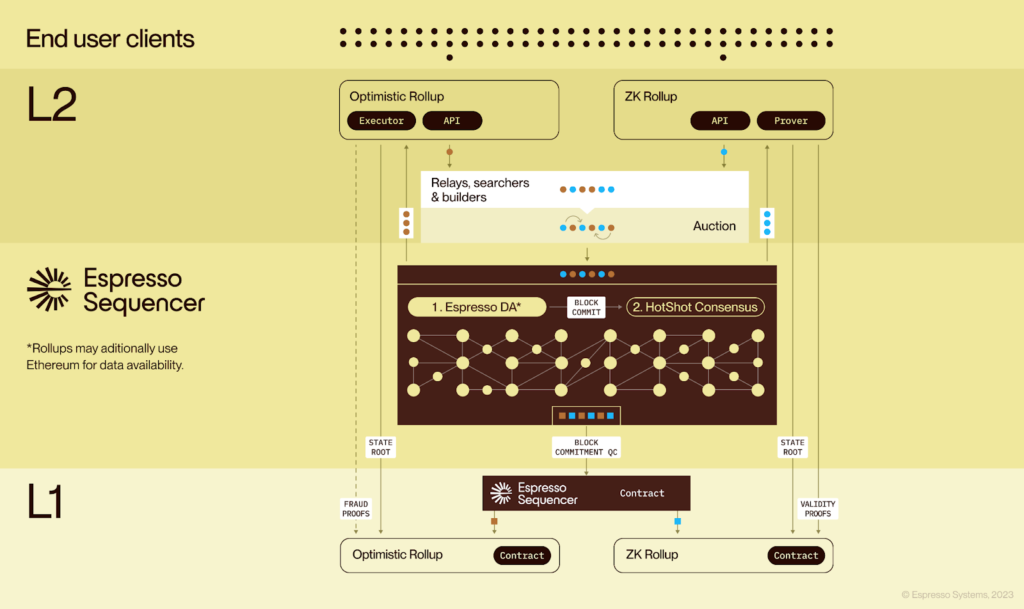
One Sequencer to rule them all. Since the switch to Proof of Stake, the Ethereum has put rollups at the heart of its roadmap. However, many networks depend on a single, centralized Sequencer. The Espresso Sequencer project aims to solve this by introducing a shared Sequencer.
Layer 2 and Sequencer: transaction schedulers
The Sequencer is a central element of second-layer rollup solutions. Its mission is to order the transactions taking place on the L2.
Once ordered, transactions are grouped into batches, then compressed before being published on the Ethereum blockchain.
Naturally, these transactions are accompanied by a cryptographic proof. This allows users to verify the validity of the rollup state.
However, most rollups currently in production rely on single, centralized Sequencerss. A situation that can lead to downtime for many rollups.
Espresso Sequencer: the Sequencer for all rollups
Faced with this centralization, many projects are working on the creation of shared Sequencers, which could operate on different L2s.
For example, Espresso Systems has launched Espresso Sequencer on the testnet. Unlike the usual monolithic Sequencers, Espresso Sequencer has been designed to operate on several rollups.

In practice, it’s based on a fork of Polygon zkEVM. Under the hood, Espresso has designed its own specialized Proof of Stake system, called HotShot.
This accepts transactions from different rollups, orders and sequences using consensus nodes, then provides this order to the rollup for execution.
HotShot uses a network-level CDN (Content Delivery Network) to ensure communications.
For the moment, this solution has only been launched on the Polygon zkEVM testnet. However, Espresso’s teams are working in collaboration with Caldera, in order to integrate the Sequencer into the Optimism technology stack.
>> Not your keys not your coins ! Choose Ledger (commercial link) as your hardware wallet of choice <<
Tiramisu: the data solution
In addition to this, Espresso Sequencer uses another solution developed by Espresso Systems, namely Tiramisu.
Thus, Tiramisu is a data availability solution which consists of three distinct data availability layers: Savoiardi, Mascarpone and Cocoa.
Firstly, Savoiardi is a corruption-resistant data availability layer, similar to Ethereum’s danksharding proposal.
Second, Mascarpone is a small DA committee that receives data directly from the CDN or directly from a block proposer, and produces a certificate that the block data is available.
Finally, Cocoa is an optional CDN that can massively speed up data dissemination and retrieval. However, its reliability is still limited.
This type of solution could well enable rollups to gain in reliability. This is because.., last June, a Sequencer failure paralyzed the Arbitrum network for several hours..
Need a secure wallet to explore the many applications of DeFi? The best solution is still a personal hardware wallet. At Ledgerthere’s something for every profile and every crypto. Don’t wait to secure your capital (commercial link)!