Inexpensive censorship. The network Ethereum finalized its transition to Proof of Stake last September. Shortly afterwards, censorship exploded following the addition of Tornado Cash to the OFAC blacklist. More recently researchers have reportedly found an extremely inexpensive method of censoring the.
Only €85 to censor Ethereum
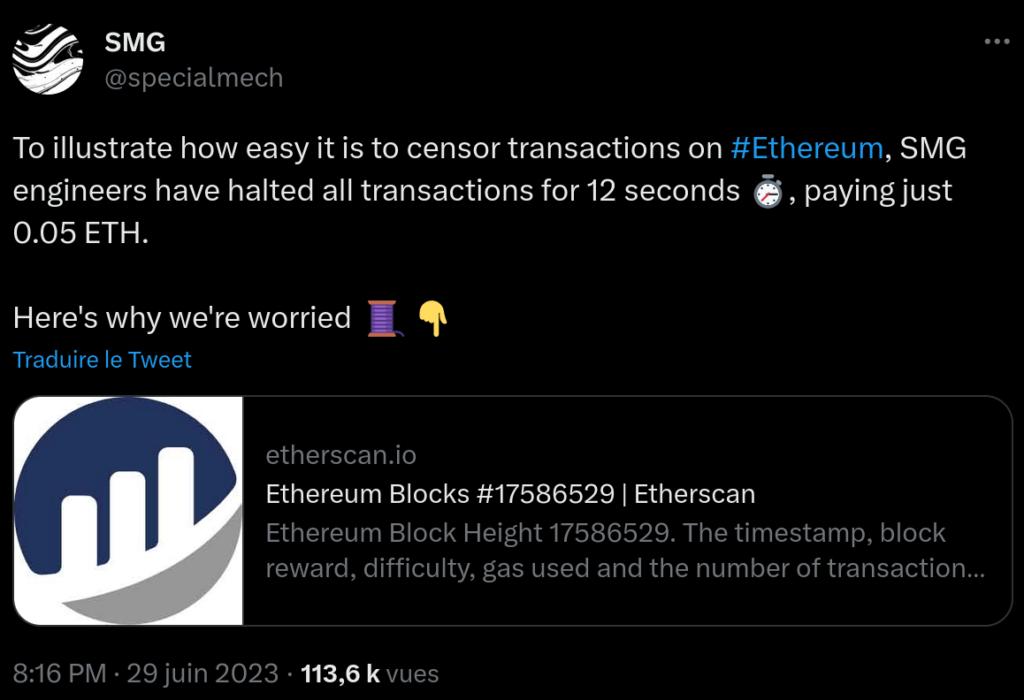
Special Mechanism Group (SMG) is a company specializing in the analysis of complex mechanisms in the blockchain ecosystem. On June 29, it published the results of a surprising experiment.

The company reveals that it has successfully paused all Ethereum transactions for 12 seconds. Even more surprisingly, the process cost only 0.05 ETHor around €85.
« To illustrate how easy it is to censor transactions on Ethereum, SMG engineers halted all transactions for 12 seconds, paying just 0.05 ETH. «
A critical situation according to SMG:
« While 12 seconds may not seem like a long time, financial systems depend on the speed with which transactions are carried out.When bidders in an auction or agents in a financial system can censor their competitors, the efficiency of these systems erodes. «
>> If you are not interested in winning 1 bitcoin, please do not click on this link (commercial link) >>
A look back at the modus operandi of this « attack ».
As pointed out by SMG, this maneuver has was made possible by the separation between the block builder and the block proposer.known as Proposer-Builder Separation (PBS).
With Proposer-Builder Separation, these two roles are dissociated. The block builder is responsible for selecting the transactions to be included in the block, while the block proposer is responsible for adding the block to the blockchain.
SMG took advantage of this to conduct its experiment. To do this, they made the highest bid among the builders and won the auction..
The relay, which is the system that transmits blocks to validators for inclusion in the blockchain, doesn’t know or care what’s inside the block. It simply delivers it for inclusion.
Therefore, they included an empty blocki.e. a block containing no transactions. This interrupted all transactions for 12 seconds.
Simple experiment or real danger? The doubt remains
Obviously, the question remains. Is this a real danger of censorship for Ethereum, or just a flashy experiment?
Let’s take a look at the repeatability. Indeed, although the experiment is functional for the duration of a block, it is severely limited when it comes to the duration of censorship.
Indeed, censoring more than one block on Ethereum via the method used by SMG’s engineers would require you to win the auction for each block you wish to censor.
In the context of Ethereum’s Proposer-Builder Separation (PBS) system, this means that you would have to bid higher than all other block builders for each block you wish to censor.
Nevertheless, as explained by one of the researchers, the problem lies not so much in its repeatability as in its feasibility at all.
» [La répétabilité sur plusieurs blocs ] is not our concern. Financial activity requires timely inclusion. We are concerned about selective censorship of competing bids in auctions. PBS allows you to do this at relatively low cost. «
SMG’s solutions against censorship on Ethereum
In parallel with its experiment, SMG has published the report of a study on censorship on Ethereum. In this study, SMG identified two possible solutions to this problem.
Firstly, SMG suggests run multi-block auctions with different bidders. This requires a faster increase in the number of blocks than in the number of bidders.
Secondly, SMG proposes toto have several competing block proposers and allow bidders to condition their tips not only on inclusion, but also on the number of proposers who include the auction in a block. This creates a kind of prisoner’s dilemma « This made censorship costly and therefore less likely.
For its part, the Ethereum mitigates OFAC censorship problem in block production. As a result, block production has fallen from 78% to 34%.
If, by the end of this article, you’re still hesitating, there’s really only one choice. Do nothing and let someone else win… or register now with Binance THE leading crypto platform, for your chance to win the game and add 1 bitcoin to your portfolio. What do you decide?